American skunk cabbage Lysichiton americanus is native to western North America. Small populations are now present in a number of locations scattered across Scotland, having escaped from botanical collections and private gardens and naturalised in the wild. In 2015, legislation was passed which makes it an offence to keep, cultivate, breed, transport, sell or release Lysichiton americanus, intentionally or unintentionally, into the environment.
About Skunk cabbage
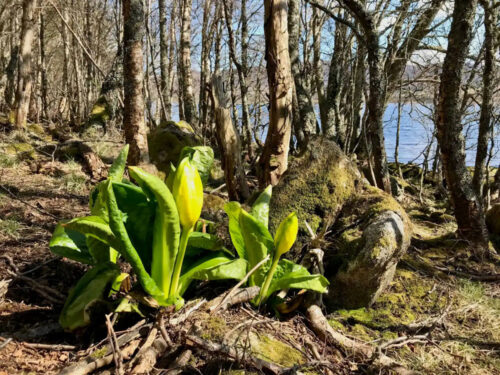
Skunk cabbage is a perennial plant which grows up to 1.5 m high and can cover over 1 sq. m. of ground. Large leathery leaves grow in the form of a rosette from thick fleshy underground rhizomes, rather like a fat leek.
Yellow skunk cabbage flower-spikes appear from March–May, followed soon after by leaves. As the fruits mature, from July onwards, the spike withers and falls onto the ground. Seeds are readily transported by water, both in flowing watercourses and across lochs, assisted by wind, water currents and fluctuating water levels. Seeds germinate in wet soil in the spring, and young plants take 3–6 years to reach maturity. Plants die back in winter. Seeds exhibit dormancy that may last 6 years, and probably longer.
Skunk cabbage grows in wet woodlands and wet scrub, along riverbanks and in bogs. It tolerates a wide range of soils and light levels. Skunk cabbage can establish moderately rapidly in suitable sites, and form dense colonies which quickly out-compete our native flora. Wet woods are a relatively scarce and sensitive habitat which supports a number of rare plants, so the impact on biodiversity can be significant.
Skunk cabbage in Loch Mhor Lysichiton americanus was planted in the water garden at Easter Aberchalder sometime before 1970. By 1980 it had started to spread from the garden and down the Aberchalder Burn to Loch Mhor. By 2000, several colonies had started to establish elsewhere around the loch. Each of these is a fresh nucleus for further expansion, and without control, there is potential for exponential growth in the population.
At least three of these sites hold small numbers of Coralroot Orchid Corallorhiza trifida, a rare saprophytic plant found in wet sites in north Britain.
Action
In 2020, a group of local residents initiated a project to control skunk cabbage in Loch Mhor under the auspices of Boleskine Environmental Network. Funding was raised from the Community Council and local landowners, and more recently Scottish & Southern Energy, to pay an experienced contractor to treat the largest concentrations (in the garden at Aberchalder, and along the Aberchalder Burn). Volunteers undertook the surveying and monitoring, and tackled the smaller outlying colonies.
Small colonies were mainly tackled by excavating plants. On sites with many large plants, this proved slow and laborious, especially in heavy, waterlogged soils. Larger colonies were controlled by spot treatment of plants with 1:40 glyphosate during the growing season. Because of the plant’s rosette form, it usually proved possible to apply herbicide without damaging non-target plants. There was a noticeable decline in all colonies following the first season’s efforts, and few, if any, plants set viable seed in 2021.
Since then, control operations using volunteers and a contractor have continued every year. Given that skunk cabbage seeds can lie dormant and remain viable for many years, it will be necessary to continue monitoring and control operations until the seedbank is completely depleted.